

Homeownership is a defining Canadian goal, but what happens when you don’t have a conventional 9-to-5 income? Many Canadians wonder, can you get a mortgage without a job or with no income at all? The answer is yes, but it requires the right knowledge and strategy, especially when it comes to low-income mortgage options available in Canada.
Canadian mortgage lenders aren’t simply income counters; they’re risk investigators. Their fundamental question is whether you can reliably repay the loan, regardless of where the money comes from. If you can’t provide classic pay stubs or T4s, lenders dig deeper into your full financial picture.
What Do No Income Mortgages Actually Mean?
Many people assume a no-income mortgage means you do not have to prove anything at all. That is not true.
In reality, lenders still want evidence that the mortgage is affordable. They may simply rely on assets, equity, credit strength, or property income instead of traditional employment documents.
Some common approaches include:
- Stated Income, Verified Assets
With this model, the borrower states their income, and the lender checks whether their savings, investments, or other assets support that claim and the mortgage payments.
- No Income, Verified Assets
This option may apply to borrowers with little or no current employment income but strong liquid assets, investment accounts, or property holdings.
- Rental or Property-Based Qualification
For investment properties, some lenders focus more on whether the property generates enough rental income to support the mortgage.
Can You Get a Mortgage With No Job or Income?
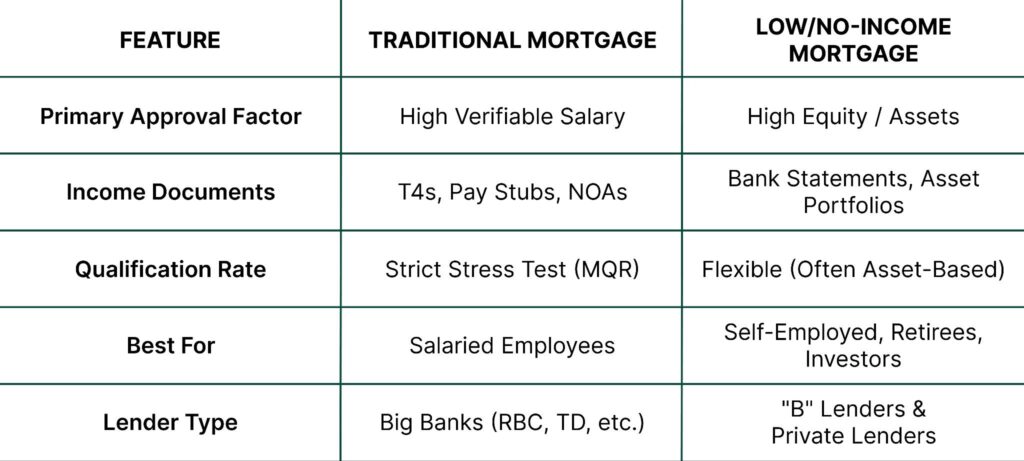
For most Canadians, an income mortgage is based on verifiable, steady earnings. To qualify for an average home today, household income requirements generally range from $80,000 to over $200,000, depending on your local real estate market and current interest rates.
Lenders determine your “buying power” using two strict formulas:
- GDS & TDS Ratios: These measure your housing costs and total debts against your gross income.
- The Mortgage Stress Test: You must prove you can afford payments at the Minimum Qualifying Rate (MQR), currently the higher of 5.25% or your contract rate plus 2%.
Can you get a mortgage with low or no income? Yes, but usually not through a standard bank program.
If you are getting a mortgage with no income, you will likely need to explore alternative solutions. This may involve working with a mortgage broker, a B lender, or an alternative lender that takes a broader view of your financial situation.
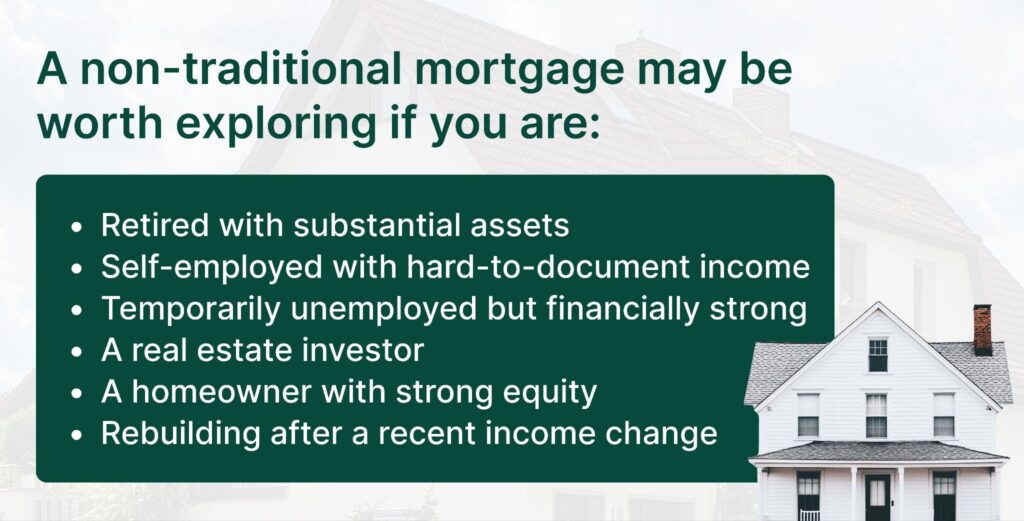
For example, you may still qualify if you are:
- Recently retired and living off investments or pension income
- Self-employed with income that is harder to document
- Between jobs, but holding substantial savings or assets
- Relying on rental income or other non-traditional income sources
- Owning significant home equity that reduces the lender’s risk
Three Mortgage Lender Options for Low-Income
It is a common myth that you need a six-figure salary to buy a home. If you are searching for a mortgage lender for low-income, you generally have three paths:
- Government Programs: Look for insured loans that allow for lower household income if your credit is strong.
- B-Lenders: These institutions specialize in mortgages for low-income earners, focusing more on your ability to manage debt than on the size of your paycheck.
- Co-signers: Adding a family member with a higher income can help you qualify for home loans in low-income situations.
What Lenders Look At Instead of Employment Income
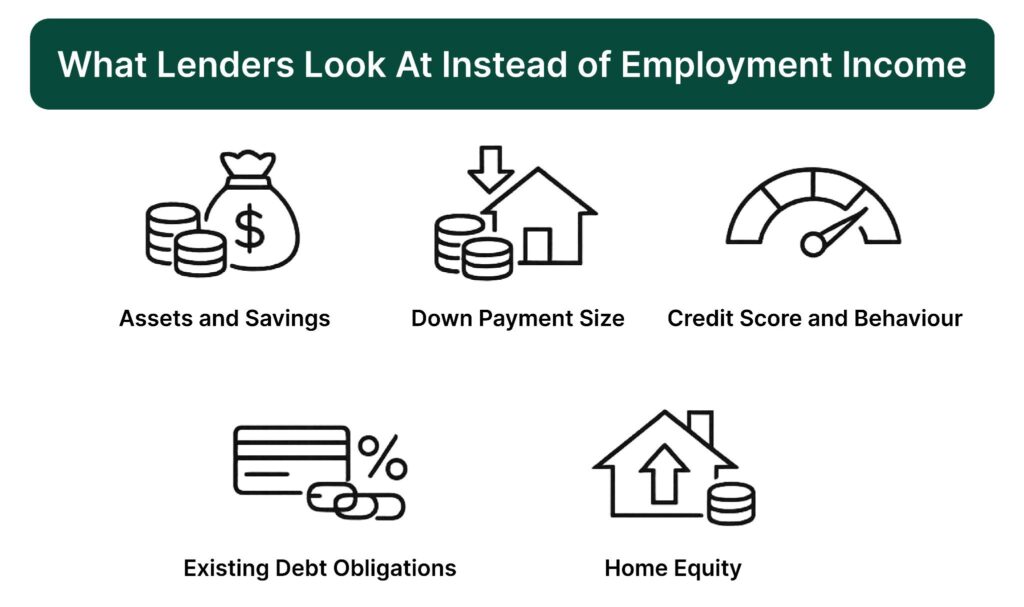
When borrowers do not fit into a traditional lending box, lenders start looking at other indicators of financial strength.
1. Assets and Savings
One of the first things lenders review is whether you have enough accessible funds to support the mortgage. This could include:
- savings accounts
- investment portfolios
- GICs
- RRSPs or TFSAs
- additional property ownership
A borrower with strong assets may be more attractive than someone with a regular paycheck but little savings. In these situations, an income mortgage assessment may focus less on salary and more on financial reserves.
2. Down Payment Size
A bigger down payment can have a significant impact. The more money you put down, the lower the lender’s risk.
For borrowers seeking a mortgage with no income, lenders often expect a down payment well above the minimum. In some cases, this may range from 20 percent to 35 percent or more, depending on the lender and the file.
This is especially true if you are approaching a mortgage lender for low-income, such as an alternative lender. A strong down payment demonstrates commitment and decreases the borrowed amount.
3. Credit Score and Credit Behaviour
A good credit profile remains critical. Even if you do not have a traditional job, strong credit tells lenders you have handled financial obligations responsibly in the past.
This matters a lot for people asking if they can buy a house with no job but good credit. Good credit alone may not guarantee approval, but it can absolutely strengthen your file, especially when paired with assets or a larger down payment. Check out the factors mortgage lenders consider when working with low-credit borrowers.
4. Existing Debt Obligations
Lenders also look at your monthly obligations. If you have high credit card balances, car loans, or other debt, the application becomes harder to justify.
On the other hand, if you have minimal debt, a lender may feel more comfortable approving a mortgage, even if your income is low, irregular, or difficult to verify.
That is why people exploring low-income home loans are often advised to reduce debt before applying.
5. Home Equity
For some borrowers, the key factor is not income at all. It is equity.
If you already own a property and have significant equity built up, that equity can open financing options that are not usually available through traditional lenders. This is particularly useful for homeowners refinancing, consolidating debt, or accessing funds while between jobs.
How to Get a Mortgage With No Income in Canada
If you are trying to figure out how to get a mortgage with no income, the process usually requires more preparation than a standard application. Here are some practical steps.
Work With a Mortgage Broker
A broker can connect you with lenders that understand non-traditional financial situations. This is often the best route if you are exploring mortgage lenders for low-income.
Gather Alternative Documents
If you cannot provide regular employment documents, you may still be able to support your application with:
- bank statements
- investment account statements
- proof of pension or retirement income
- rental income records
- business financials
- proof of property ownership and equity
Improve Your Credit Before Applying
If your credit score is already strong, that helps. If it needs work, paying down balances and avoiding missed payments before applying can make a meaningful difference.
Consider a Co-Signer
A co-signer with stable income can strengthen the application and reduce lender concerns.
Explore Alternative Lending
This is often where a no-income mortgage approval is more realistic. Alternative lenders are generally more flexible than banks, although the trade-off is often a higher rate or added fees.
Risks and Trade-Offs to Understand
Before moving forward, it is important to be realistic about the downsides.
Higher Interest Rates
Alternative and private mortgages usually come with higher rates than traditional bank mortgages.
Additional Fees
You may face broker fees, lender fees, or legal costs that are higher than standard financing.
Shorter Terms
Some no-income or low-document mortgages are structured as short-term solutions rather than long-term mortgage products.
Greater Financial Pressure
If you do not have a stable income coming in, taking on a mortgage can create stress. It is important to choose a realistic payment level, not just technically approvable.
Who May Benefit From These Options?
How Equity Rich Can Help
At Equity Rich, we understand that not every borrower fits the bank’s checklist. A traditional job is not the only sign of financial strength, and a missing pay stub does not always mean you should be denied financing.
We work with borrowers who may be self-employed, newly retired, between jobs, or navigating complex financial situations. Instead of looking only at employment income, we consider the full picture, including equity, assets, credit, and property value.
Equity Rich can help you review your mortgage options and find a path that fits your financial reality.

FAQs
- Can you get a mortgage without a job in Canada?
Yes, in some cases. Some lenders may approve a mortgage without a traditional job if you have strong credit, assets, home equity, or a large down payment.
- Can I get a mortgage without proof of income?
You may be able to, but lenders usually require other forms of financial proof, such as bank statements, investment accounts, or property equity.
- What is a no-income verification mortgage in Canada?
A no-income verification mortgage in Canada is usually an alternative lending product where approval is based less on standard employment documents and more on assets, equity, credit, or other financial factors.
- Can I buy a house with no job but good credit?
Good credit helps a lot, but it is usually not enough on its own. Lenders may also want to see savings, a strong down payment, or other signs that you can manage the mortgage.
- How do mortgage lenders for low-income assess applications?
Mortgage lenders for low-income borrowers often look at debt levels, credit history, down payment size, assets, and the overall affordability of the mortgage rather than salary alone.
Ready to Access Your Home Equity?
No credit check. No income verification. Funds in as little as 48 hours.
Get My Free Assessment