

Navigating the real estate market in 2026 requires more than just a good eye for property; it requires strategic financial timing. One of the most common hurdles homeowners face is the “timing gap,” the period when you’ve found your dream home but haven’t yet received the funds from the sale of your current one.
This is where a Bridge Mortgage (also known as bridge financing) comes into play. It acts as a literal financial “bridge” to get you from one property to the next without losing out on a deal.
What is a Bridge Loan in Simple Terms?
In the simplest terms, a short-term bridge loan is a temporary loan that allows you to use the equity in your current home to pay the down payment on a new one.
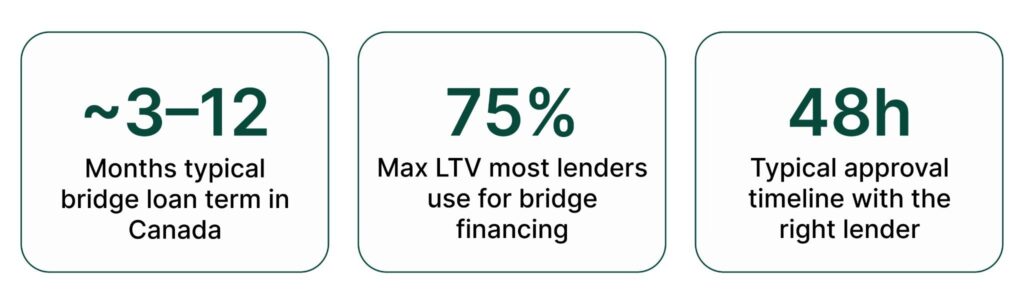
Think of it as a short-term advance. It covers the gap between the closing date of the house you are buying and the closing date of the house you are selling. Because it is designed to be temporary, these loans typically last anywhere from a few weeks to six months.
How Bridge Loans Work: A Step-by-Step Guide
Understanding how bridge loans work is essential for any homeowner looking to sell and buy a house at the same time. Here is the typical lifecycle of a bridge mortgage in the Canadian market:
The mechanics are simpler than most people expect. Here’s the typical sequence:
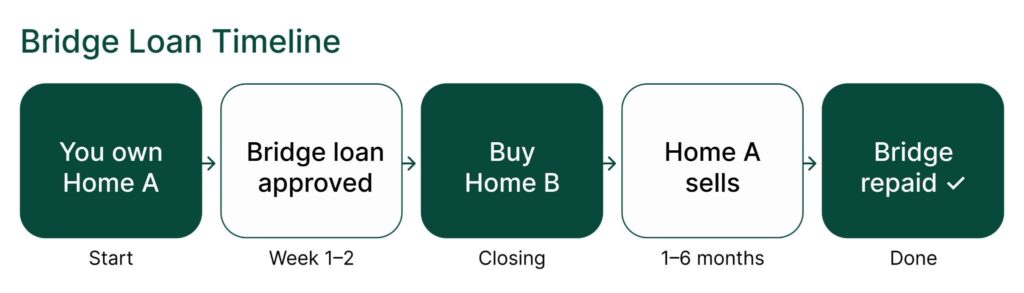
1. You Find Your Next Home And Make An Offer
You’ve found the property you want, but your current home hasn’t sold yet, or the closing dates don’t align. You need funds now.
2. A Lender Calculates the Equity in Your Current Home
The lender looks at your home’s current market value and subtracts what you still owe on your mortgage. At Equity Rich, we specialize in alternative lending solutions that prioritize your property’s potential over rigid banking criteria. One of the most critical factors in securing your next move is understanding how much capital you can unlock from your current home.
Up to 75-80% of your home’s appraised value can be accessed as a bridge loan. This percentage is known as the Loan-to-Value (LTV) ratio.
Bridge Loan Amount = (Home Value × LTV%) − Outstanding Mortgage Balance
3. The Bridge Loan Funds Your New Purchase
The lender advances the funds so you can close on Home B. You now temporarily own two properties. During this period, interest accrues on the bridge loan, but many structures require no monthly payments until the bridge is repaid.
4. Your Original Home Sells
The sale closes, and the proceeds are used to pay off the bridge loan in full, including any accrued interest and fees. Whatever remains is yours.
5. Bridge Is Cleared, You Move Into Your New Home
The process is complete. No more bridge, no more double carrying costs. You settle into Home B free of the temporary loan.
When Should You Use a Bridge Loan?
Bridge financing isn’t for everyone, but in certain situations, it’s the smartest tool available. Here are the most common scenarios where a bridge mortgage makes sense:
1. Closing Dates Don’t Align
For example, your new home closes before your current home sale closes. A bridge loan can cover the gap between the two dates.
2. You Want To Avoid Moving Twice
Instead of moving into temporary housing or paying for storage, a bridge loan can give you enough time to move directly from your current home into your new one.
3. You are Buying a New Build Or Builder Home
New construction closing dates can shift. Bridge financing can help if your builder closing happens before your current home sale is complete.
4. Home Equity Accounts For The Majority Of Your Wealth
Some Canadian homeowners have strong equity but limited available cash. A bridge loan can help unlock that equity for a short period while the sale is finalized.
5. You Need Time to Sell Properly
Rather than rushing to accept a lower offer just to free up funds, bridge financing may give you more flexibility during the sale process.
The Advantages and Risks of Bridge Loans: What to Watch For
Here are the main pros and cons of bridge financing.
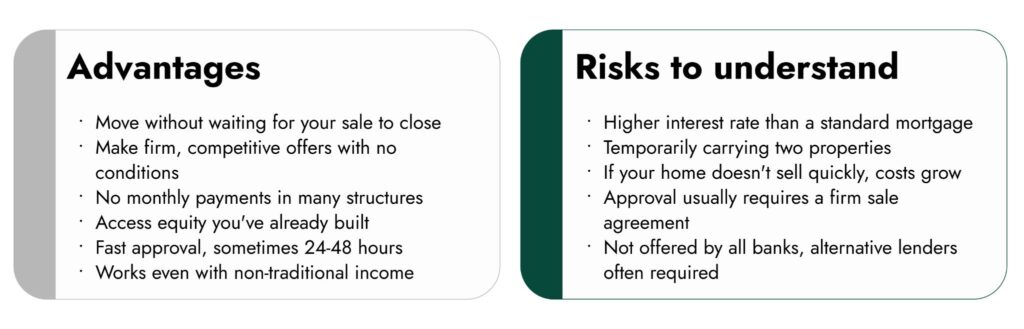
The Advantages: Why Homeowners Use Bridge Financing
The primary benefit of a real estate bridge loan is the freedom it provides. It transforms a stressful, rigid timeline into a manageable transition.
- Financial Flexibility: You can make a firm offer on your dream home before your current one is sold. This is essential for staying ahead in a competitive market with a bridge mortgage.
- Stress-Free Moving: By owning both homes for a short period (typically 2 weeks to 90 days), you have the luxury of time. You can move at your own pace or even complete minor renovations before officially moving in.
- Avoiding “Conditional” Offers: In 2026, sellers often reject offers that are “conditional on the sale of the buyer’s property.” A bridge loan allows you to present a “clean” offer, making you a much more attractive buyer.
- No Monthly Payments: Most bridge loans are structured so that the interest is “rolled up” and paid as a closing cost from the proceeds of your home sale. You won’t have to worry about cash flow during the transition.
The Risks: What Could Go Wrong?
While the benefits are significant, bridge financing is an asset-backed, short-term commitment that carries inherent risks.
- Higher Interest Rates: Because these are high-convenience, short-term products, interest rates are typically Prime + 3% to 5%. In the current market, expect rates to range between 8% and 12%.
- The “Sale Fall-Through” Risk: If the buyer of your current home backs out, you are left holding two properties and a growing interest bill on the bridge loan. This is why most traditional lenders require a firm sale agreement.
- LTV Limitations: If you have already tapped into your home equity through a HELOC or second mortgage, you might find your LTV (Loan-to-Value) ratio is too high to qualify for additional bridging.
- Compounding Fees: Beyond interest, bridge loans often come with administrative fees (ranging from $200 to $500) and increased legal fees for the additional registration on your title.
Equity Rich Insight: Most traditional banks will only offer a bridge loan if you have a firm sale and are getting your new mortgage through them. As alternative lenders in the Canadian market, we offer more flexibility, even if your situation is complex, such as being self-employed or needing a no-income mortgage.
Bridge Loan vs. Other Options
Before committing to a bridge loan, it’s worth knowing what else is on the table:
A Home Equity Line of Credit lets you draw on equity as needed but requires more setup time, and your lender must allow it alongside a pending sale.
A home equity loan is a lump-sum second mortgage that lets you borrow against the equity in your home. It is usually more structured than a bridge loan and may be useful when you need a set amount of money, but it can take longer to arrange and may come with higher qualification requirements.
A flexible, fast option through non-bank lenders. Often, the bridge financing itself is structured as a private mortgage, especially for non-traditional borrowers.
Your Equity Is Working: Make Sure Your Lender Is Too
Bridge loans are one of the most powerful tools for homeowners in transition, but only if they’re structured correctly for your situation. At Equity Rich, we look at your home, your equity, and your goals and build a custom solution around what’s actually affordable for you.
Get Your Free Home Equity Estimate
FAQs
1. How long does it take to get a bridge loan?
Usually, it can be arranged in a few days to a week, provided you have the signed purchase and sale agreements ready.
2. Can I get a bridge loan without a firm sale?
Most traditional banks say no. However, alternative lenders in the Canadian market may consider a home equity bridge loan even if your house hasn’t been sold yet, provided there is sufficient equity.
3. Is bridge financing expensive?
While the interest rate is higher, you only pay it for a short period (e.g., 30 days). The actual dollar cost is often worth the peace of mind of securing your new home.
4. What is the maximum LTV for a bridge loan?
Most lenders cap the LTV at 75-80% to account for the costs of selling the original property.
5. What’s the difference between a bridge loan and a second mortgage?
A bridge loan is specifically designed to be short-term (weeks to months) and is tied to an upcoming property sale. A Second Mortgage is a longer-term equity loan that sits behind your primary mortgage. Bridge loans are often structured as short-term second mortgages, but not all second mortgages are bridge loans.
6. Can I get a bridge mortgage if I am self-employed or have no regular income?
This is where alternative lenders shine. Banks often decline borrowers who can’t show traditional T4 income. Alternative lenders focus more on your home’s equity and the strength of the transaction. If you’re self-employed, explore the Mortgage for Self-Employed options available through Equity Rich.
Ready to Access Your Home Equity?
No credit check. No income verification. Funds in as little as 48 hours.
Get My Free Assessment