

Retirement is supposed to be a time when things slow down. But when it comes to finances, many Canadians find themselves asking new questions, especially about housing.
Maybe you’re thinking about refinancing. Maybe you want to help a family member buy a home. Or maybe you’re simply wondering, can a retired person get a mortgage in Canada? It’s a fair question.
A lot of people assume that once you stop working, getting approved for a mortgage becomes nearly impossible. After all, most advice around mortgages focuses on stable jobs, steady income, and long-term earning potential.
But real life doesn’t always fit that model.
The truth is, mortgages for seniors do exist, and many Canadians continue to qualify for financing well into their 60s, 70s, and beyond. The difference is that lenders look at things a little differently.
Why Getting a Mortgage Feels Different After Retirement
When you’re working, mortgage approval is fairly straightforward. You show your income, your credit score, and your debt levels, and the lender decides if you qualify.
In retirement, the structure changes.
Instead of a salary, you might be relying on:
- Canada Pension Plan (CPP) or Old Age Security (OAS) payments
- A workplace pension
- Investment income or withdrawals
- Savings you’ve built over time
None of this is “bad” in the eyes of a lender, but it does require a different kind of evaluation.
Can a Retired Person Get a Mortgage in Canada?
The short answer is yes. Under the Canadian Human Rights Act, lenders cannot deny you a mortgage based on age. However, they will look at your financial profile through a different lens than they would for a 30-year-old professional.
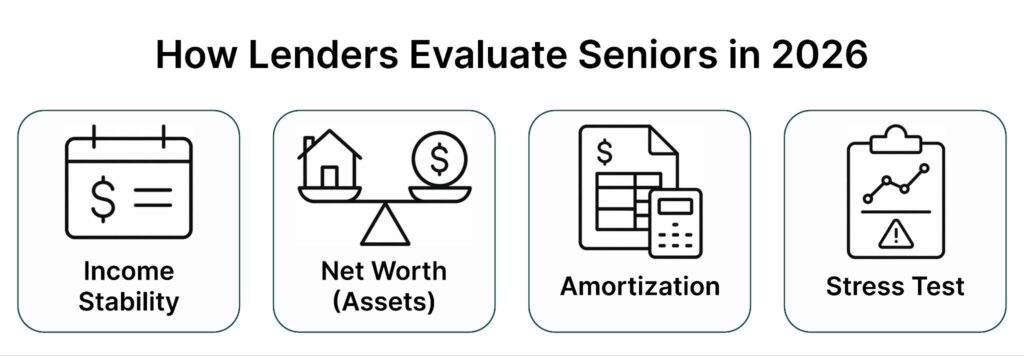
To qualify for senior home loans, lenders focus on four main pillars:
- Income Stability: Lenders accept CPP, OAS, and Guaranteed Income Supplement (GIS). They also look at private employer pensions and scheduled Registered Retirement Income Fund (RRIF) withdrawals.
- The Net Worth Maneuver: If your monthly pension is low, but your savings are high, many lenders now offer high net worth programs. They look at your liquid assets (stocks, bonds, GICs) and “calculate” an implied income.
- Amortization: While younger buyers get 25–30 years, seniors may be offered shorter windows (e.g., 10–15 years) to ensure the loan is manageable, though this isn’t a hard rule if equity is high.
- The Stress Test: Even in 2026, you must prove you can handle payments if rates rise. You’ll be tested at your contract rate plus 2%, or the 5.25% floor, whichever is higher.
Top Mortgage Options for Seniors and Retirees
When exploring mortgages for seniors, it’s important to understand that not all options work the same way. The right solution depends on your income, equity, and long-term goals.
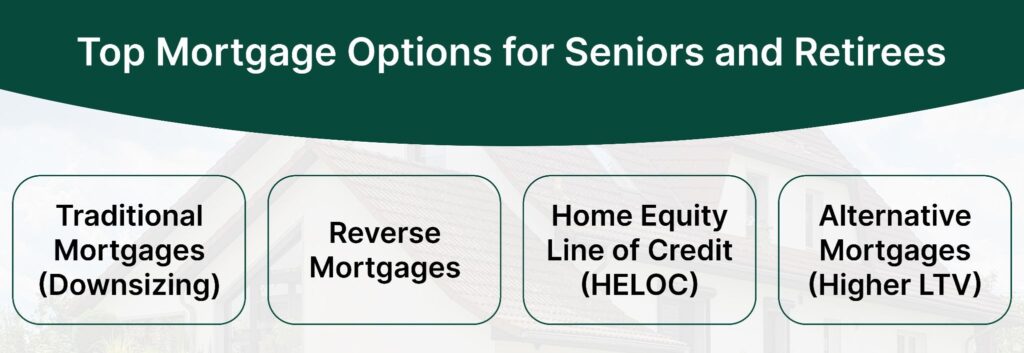
1. Traditional Mortgages (Best for Downsizing)
If you are selling a large family home to buy a smaller property, you are a “low-risk” borrower.
- The Strategy: Use the equity from your sale as a massive down payment (50% or more). This ensures that a standard pension can easily cover your monthly payments.
- Amortization: While you can still get a 25-year mortgage, many seniors opt for 10 or 15 years to ensure the debt is cleared sooner.
2. Reverse Mortgages (Best for Aging in Place)
A reverse mortgage allows homeowners aged 55+ to access a portion of their home’s equity without making monthly payments.
In Canada, borrowers can typically access up to about 55% of their home’s value, depending on factors like age, location, and property type.
Pros:
- No required monthly payments
- Tax-free funds
- You remain in your home
Cons:
- Higher interest rates than traditional mortgages
- Interest compounds over time
- Reduces the equity available in the future
While reverse mortgages offer convenience, they also limit how much equity you can access upfront.
3. Home Equity Line of Credit (HELOC)
A HELOC is a revolving line of credit secured by your home.
- Why seniors use it: It’s great for unexpected medical costs or home repairs. You only pay interest on what you use.
- The Benefit: You only pay interest on the amount you actually withdraw. Many Canadian HELOCs allow for interest-only payments, which keep monthly costs low.
- The Risk: Most HELOCs are “callable” by the bank, and rates are variable. If your income is strictly fixed, a spike in prime rates can make the interest-only payments difficult to manage.
If the “variable” nature of a HELOC feels too risky for your budget, a home equity loan might be the better fit.
- Fixed Stability: Unlike a HELOC, a home equity loan provides a one-time lump sum with a fixed interest rate.
- Predictability: Your monthly payment is locked in for the life of the loan.
- The Trade-off: You begin paying interest on the full amount immediately, and payments include both principal and interest, which are higher than “interest-only” HELOC payments.
4. Mortgages for Low-Income Seniors (Alternative Lending)
Most reverse mortgages in Canada allow homeowners to access up to about 55% of their home’s value. While this works for some, it can feel limiting for those who need access to more funds.
In comparison, some alternative mortgage solutions, such as those offered by Equity Rich, can provide access to a higher loan-to-value (LTV), sometimes reaching 75% to 80% depending on the situation.
This means:
- More usable equity upfront
- Greater flexibility for refinancing, debt consolidation, or lifestyle needs
- More control over how you structure your finances in retirement
For seniors with strong home equity but limited or no income, this type of solution can bridge the gap between traditional lending restrictions and real financial needs.
Challenges to Keep in Mind
While not a law, some traditional lenders are wary of amortizations that extend past a borrower’s 75th or 80th birthday unless there is a co-signer or significant liquid assets.
Life Insurance Requirements
Some lenders may suggest or require mortgage life insurance. However, for seniors, this can be prohibitively expensive. It is often more cost-effective to ensure you have a standard term-life policy or sufficient equity to cover the loan upon passing.
Before You Apply
- Boost Your Credit: Even a 20-point increase can land you a lower interest rate.
- Reduce Small Debts: Clear out credit cards or car loans to improve your “Debt-to-Income” ratio.
- Gather Documentation: Have your T4As, OAS/CPP statements, and the last three months of bank statements ready.
- Consult a Specialist: Don’t just walk into your local branch. Speak to a mortgage broker who has access to reverse mortgage providers and alternative lenders.
If you’re ready to explore your options further, consider opting for mortgage services in Canada. Compare the different mortgage products side by side, not just the interest rate, but also payment flexibility and impact on your lifestyle and legacy.
Remember: while the path may require additional planning, aging in place with financial peace of mind is absolutely achievable. Your home can continue to work for you in retirement, not become a burden.

Frequently Asked Questions (FAQs)
Can I get a mortgage at 60 years old?
Absolutely. Many Canadians at 60 are still working or have just started their pensions. As long as you meet the debt-service ratios (GDS/TDS), you are eligible for the same rates as any other borrower.
- Can I use my RRSP or RRIF as income for a mortgage?
Yes. Lenders will look at your history of withdrawals. Lenders usually don’t treat your Registered Retirement Savings Plan (RRSP) as income on its own. However, if you are actively withdrawing money from it, especially through a Registered Retirement Income Fund (RRIF), those withdrawals can be counted as income. If you can show a consistent pattern of drawing $2,000/month from your RRIF for the last two years, they may include that as part of your qualifying income.
In some cases, even if you’re not withdrawing regularly, lenders may still consider the size of your RRSP or RRIF as an asset, which helps strengthen your application.
- Are there “pension-only” mortgage programs?
While there isn’t a government program named this, many credit unions specialize in “pensioner-friendly” lending, offering more flexibility on income verification than the big five banks.
- What is the best mortgage option for low-income seniors?
It depends on your situation. Some seniors use reverse mortgages to avoid monthly payments, while others explore alternative or equity-based mortgages that allow access to more of their home’s value. The right option comes down to your income, equity, and long-term goals.
- Do I need medical insurance to get a senior home loan?
No, but it is often recommended. Lenders do not legally require you to have life or medical insurance to approve a mortgage. However, because mortgage life insurance premiums can be very high for those over 65, many seniors prefer to ensure their existing term-life insurance or the equity in the home is sufficient to cover the debt. This ensures the burden doesn’t fall on your heirs.
Ready to Access Your Home Equity?
No credit check. No income verification. Funds in as little as 48 hours.
Get My Free Assessment